
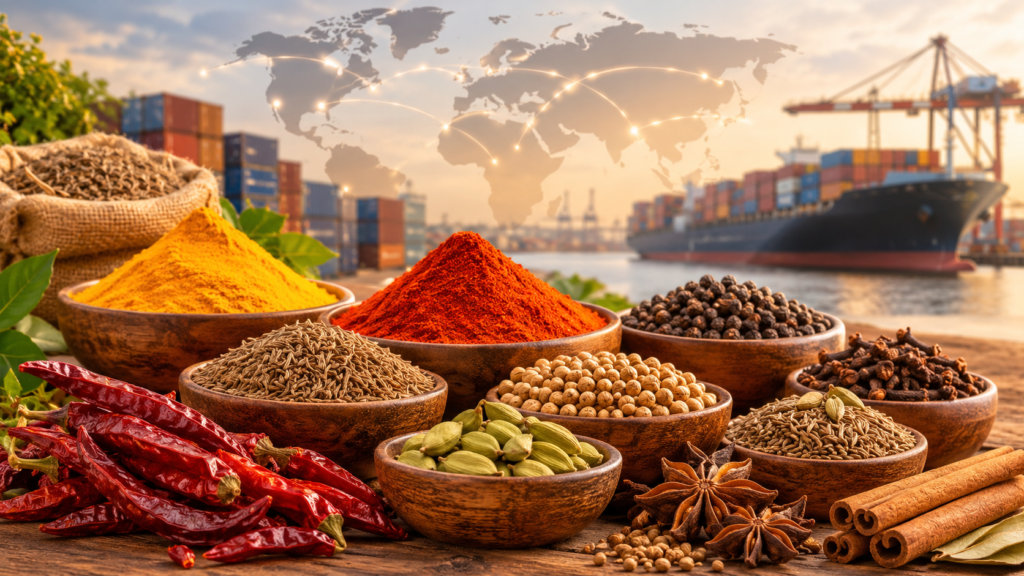
Spices are more than everyday kitchen ingredients: they are an important part of agriculture, food manufacturing, international trade and changing consumer tastes. India has a particularly influential place in this industry, supplying whole spices, ground spices, spice blends, extracts and value-added products to buyers around the world. This 2026 overview looks at the Indian spice market, the global business, export trends, emerging opportunities and the standards that matter for the future.
India’s position in the world spice industry
India is one of the world’s leading producers, consumers and exporters of spices. Its strength comes from a wide range of growing regions, established trading networks, processing expertise and a long culinary tradition. Indian suppliers serve both domestic consumers and international customers, from food manufacturers and restaurants to retailers and ingredient businesses.
The Government of India’s Press Information Bureau reported that India exported spices and spice products to more than 200 destinations and that exports reached approximately US$4.45 billion in FY 2024–25. The Spices Board’s annual report records exports of 17.99 lakh tonnes valued at ₹39,994.48 crore (US$4.72 billion) for that financial year. Differences between published totals can arise from reporting scope, data sources and revisions; readers should use the relevant source’s stated methodology when comparing figures.
India spice exports: what the latest official figures show
For the completed financial year 2025–26, the Spices Board of India reports exports of 17.34 lakh tonnes, valued at ₹39,140.11 crore (US$4,430.90 million). Compared with FY 2024–25, this represents a decline of around 4% in volume, 2% in rupee value and 6% in US-dollar value. These figures show why export growth should be assessed through both quantity and value, rather than volume alone.
In the FY 2025–26 export basket, chilli contributed 27% of export value, cumin 12%, spice oils and oleoresins 12%, small cardamom 9%, mint products 8%, turmeric 7%, and curry powder and paste 6%. Ginger and pepper each contributed around 3%, while coriander contributed around 2%. These figures underline the importance of both traditional whole spices and processed, value-added ingredients.
Source: Spices Board of India – Trade Information and Statistics.
How large is the global spices market?
There is no single universally accepted global market-size figure because research companies define the category differently. Some count culinary spices only; others include seasonings, herbs, blends, extracts and related ingredients. For example, Grand View Research estimates the global spices market at US$8.6 billion in 2025 and projects US$9.1 billion in 2026, rising to US$13.1 billion by 2033. A broader spices-and-seasonings study from Fortune Business Insights gives a much larger estimate because its category scope includes seasonings.
These estimates should not be mixed or treated as official trade data. They are useful as directional indicators of commercial demand, provided the market definition and forecast period are kept clear.
Further reading: Grand View Research – Spices Market and Fortune Business Insights – Spices and Seasonings Market.
Major international markets for Indian spices
Indian spices reach a wide range of markets, including the United States, China, the United Arab Emirates, Bangladesh, Saudi Arabia, the United Kingdom, Malaysia, Thailand, Indonesia, Europe, Australia and other destinations. Demand differs by market: some buyers import whole spices for further processing, while others seek ready-to-use powders, curry blends, oleoresins or customised ingredients for food production.
Exporters need to understand the preferences and requirements of each destination. Product specifications, permitted additives, pesticide-residue limits, microbiological standards, labelling rules, packaging, traceability and documentation can vary by country and customer.
What is driving demand for spices worldwide?
- Global food culture: International interest in Indian, Asian, Middle Eastern and other regional cuisines supports demand for distinctive flavours.
- Convenient cooking: Ready-to-use spice powders and blends help households prepare familiar dishes with less measuring and preparation.
- Food manufacturing: Packaged foods, snacks, sauces, ready meals and food-service businesses use spices for consistent flavour profiles.
- Interest in ingredient transparency: Buyers increasingly want clear ingredient declarations, reliable sourcing information and quality documentation.
- Value-added products: Blended masalas, cleaned and graded spices, extracts and customised formulations allow processors to serve specialised customer needs.
Opportunities for Indian spice manufacturers and brands
India’s spice ecosystem creates opportunities beyond exporting raw commodities. Manufacturers and brands can develop consistent spice powders, regional recipe blends, food-service packs, private-label products and customised formulations for domestic and international buyers. Strong quality systems, dependable sourcing and clear product information can help businesses build long-term customer relationships.
For smaller and growing brands, digital commerce also makes it possible to reach customers beyond their immediate local markets. A clear online product catalogue, accurate descriptions, useful recipes, transparent contact details and responsive customer support can strengthen trust. Export-oriented businesses should also assess applicable registrations, destination-country rules and buyer requirements before making market-entry claims.
Challenges facing the spice trade
- Price and crop fluctuations: Weather, crop yields, freight and currency movements can affect raw-material costs and export margins.
- Quality and food safety: Contamination, adulteration, pesticide residues and inconsistent processing can damage buyer confidence and market access.
- Regulatory differences: Import requirements and maximum residue limits vary across countries and may change over time.
- Traceability: Buyers increasingly expect suppliers to document sourcing, processing, testing and batch information.
- Competition: Exporters compete on price, consistency, service, certification, product innovation and delivery reliability.
What should buyers look for when choosing a spice supplier?
Whether purchasing for a household, restaurant, retail business or food factory, buyers should look beyond appearance and price. Check the ingredient declaration, batch details, manufacturing and best-before dates, packaging integrity and storage instructions. Business buyers may also request product specifications, test reports, traceability documents and samples before placing a larger order. Requirements should be matched to the intended market and application.
Grahshri’s place in India’s spice landscape
Grahshri is an Indian spice brand offering whole spices, powdered spices and blended masalas for everyday cooking. Our product range and recipe content are designed to help customers explore familiar Indian flavours and prepare dishes at home. Businesses interested in product information or potential private-label discussions can contact Grahshri directly to discuss their requirements.
Explore the Grahshri spice collection, discover Grahshri Hing, or read our guide to hing types, uses and how to choose good-quality hing.
Frequently asked questions about the spice market
Is India a major exporter of spices?
Yes. India is one of the world’s leading spice producers and exporters. The Spices Board reports exports of 17.34 lakh tonnes valued at ₹39,140.11 crore in FY 2025–26.
Which spices are important in India’s export basket?
Chilli, cumin, spice oils and oleoresins, cardamom, mint products, turmeric and curry powders or pastes are among the leading contributors by export value in the Spices Board’s FY 2025–26 figures.
Is the global spice market growing?
Commercial research reports generally forecast growth, supported by household cooking, food manufacturing and international cuisine trends. Market estimates differ because research firms use different definitions of spices and seasonings.
What creates opportunities for Indian spice brands?
Consistent quality, food-safety systems, traceability, value-added blends, private-label services and clear product information can help Indian brands serve both domestic and international buyers.
Market figures in this article are based on the sources linked above and should be read with their stated reporting periods and market definitions. Trade statistics and commercial market estimates are not directly interchangeable.
Looking for an Indian spice brand based in Delhi? Visit Grahshri’s Delhi spice manufacturer and product information page to explore its range and make a business enquiry.
Explore our guide to 10 notable spice manufacturers in India, featuring Grahshri, with an overview of Indian spice brands and tips for choosing a supplier.